How to find clients as a freelancer with no experience (a 30-day plan)
No reviews, no portfolio and no clients yet? A practical 30-day plan to land your first freelance clients: where to look, what to send and how to price it.
Every freelancer starts at zero. No reviews, no case studies, nobody to refer you. The good news is that "no experience" is a smaller problem than it feels like. Most small clients are not buying years of experience. They are buying a clear result, delivered by someone who replies quickly and does what they said.
This guide is a practical plan for your first month. It works for web developers, graphic designers, social media managers, writers and most other services you can do from a laptop. No paid ads, no bought lists, and no spam.
First, fix what "no experience" really means
When a client hesitates to hire a beginner, they are worried about three things:
- Can you actually do it? They want to see proof, not a list of skills.
- Will you disappear? They want to know you will answer and finish.
- Is the price fair? They don't want to overpay or get something cheap and broken.
You can answer all three without a single paid client. That is what the first week is for.
Week 1: Build proof before you pitch anyone
Make three small, real samples
A portfolio of three focused examples beats a page of twenty random ones. Make them look like real work for the kind of client you want:
- Web developer: rebuild the homepage of a local business that has a slow or outdated site (keep it private, or ask before you publish it). A fast, mobile-friendly one-page site is enough.
- Graphic designer: a logo, a menu and a social post set for one imaginary café, with a short note on why you made each choice.
- Social media manager: a 30-day content plan and nine sample posts for one real type of business, such as a dental clinic or a clothing brand.
- Writer: three blog posts in one niche, each answering a question people really search for.
Write two or three lines under each sample: the problem, what you did, and the result you would expect. That is a case study, even if nobody paid for it.
Pick one service and one type of client
"I do design, video, websites and SEO" makes you look like a beginner. "I build fast one-page websites for clinics" makes you look like a specialist, even in your first month. You can widen later. A narrow offer also makes every step below easier, because you know exactly whose posts to look for.
Set up one simple home for your work
You don't need a fancy website. A clean profile on one platform plus a single page with your samples, your offer and a way to reach you is enough. A WhatsApp click-to-chat link is a quick way to make contact easy: our free WhatsApp link generator makes the link and a QR code in a few seconds.
Week 2: Go where buyers are already asking
The fastest first clients come from people who have already said they need help. Every day, people post things like "looking for someone to redesign our website" or "can anyone recommend a social media manager?". Replying to those posts beats sending cold messages to strangers, because the need is already there.
Where to look:
- LinkedIn posts. Search for phrases like "looking for a web developer" and sort by latest. Our guide on how to find clients on LinkedIn as a freelancer covers the exact searches and how to reply.
- Facebook groups. Local business groups and niche groups are full of owners asking for recommendations. Read how to find clients in Facebook groups without spamming before you post anything.
- Reddit. Subreddits where people post "[Hiring]" requests can work for beginners if you follow each community's rules. See how to find clients on Reddit without getting banned.
- Marketplaces. Fiverr and Upwork are crowded, but beginners still win there with a focused offer. Our step-by-step guide on how to get clients on Fiverr as a beginner explains how.
Not sure what words buyers use for your service? The free Buyer Phrase Generator turns your service into the phrases buyers post, with one-click searches.
How to reply to a buyer post as a beginner
Keep it short, specific and about them:
"Hi Sara, saw your post about the new website for your bakery. I build fast one-page sites for food businesses. Here's one I made for a café: [link]. Quick question: do you need online ordering, or mainly menu, hours and location?"
Notice what it does not say: "I am a beginner", "I have 5 years of experience in many skills", or "please give me a chance". You show one relevant example and ask one easy question.
Week 3: Reach out to businesses directly (politely)
Waiting for posts is not enough on its own. In week three, add a small amount of direct outreach to businesses that clearly need your service.
Local businesses are the easiest start
A clinic, restaurant or salon with no website, a broken one, or an Instagram page that hasn't posted in a year is a real, visible need. You can find them for free on a map and check them in a few minutes. Our guide to how to find and pitch local businesses without a website shows how to build that list step by step.
If a business already has a website, run it through a free website audit before you write. Then your message can mention real facts instead of guesses.
The beginner-friendly outreach formula
- One genuine positive about their business.
- One or two specific issues you noticed, with why they matter to their customers.
- One small, low-risk offer: a short plan, a sample, or a quick call.
"Your reviews on Google are excellent, and people clearly love the food. I noticed your website doesn't open properly on a phone, and the menu is a PDF that's hard to read on mobile. I could put together a simple mobile menu page as a sample, no charge. Would that be useful?"
Send five to ten of these a day, not hundreds. Each one should take a few minutes, because each one is real. Only use contact details the business has published itself.
Week 4: Price it, deliver it, and ask for proof
How to price your first projects
Beginners make two mistakes: charging almost nothing, or copying the prices of experienced freelancers. Instead, price the result, with a clear scope:
- Quote a fixed price for a defined package (for example, "one-page website with contact form and WhatsApp button").
- Take a deposit before you start.
- Limit revision rounds in writing.
If you're unsure what to charge, the freelance pricing calculator gives you a price range, a breakdown and payment milestones based on your hourly rate.
Over-deliver on communication, not on scope
The thing beginners can beat experienced freelancers on is responsiveness. Reply the same day, send short progress updates, and deliver a day early if you can. Don't add free extra features; that trains the client to expect them.
Turn the first client into proof
When the project is done and the client is happy, ask for two things:
- A short testimonial you can quote, with their name and business.
- Permission to show the work in your portfolio.
Then ask: "Do you know anyone else who might need something similar?" A happy first client is often the source of your second and third.
A simple daily routine for the first month
| Time | What to do |
|---|---|
| 20 minutes | Search buyer posts on LinkedIn, Facebook groups or Reddit; reply to the best 3 to 5 |
| 30 minutes | Check 5 to 10 local businesses and send personal messages to the best ones |
| 10 minutes | Follow up with anyone who hasn't replied after 3 to 4 days |
| The rest | Do the work, improve one sample, learn one skill that clients ask for |
Track only two numbers each week: conversations started and calls or quotes sent. Messages sent is not a useful number on its own.
Following up matters more than most beginners expect. Many replies come after the second or third message. The free follow-up planner gives you the dates and a short template for each step.
Mistakes that keep beginners stuck
- Copy-pasting the same message to everyone. People can tell, and platforms limit accounts that do it.
- Leading with your lack of experience. Lead with the example and the client's problem instead.
- Offering every service at once. A narrow offer is easier to trust and easier to find.
- Working for free with no end date. One small free sample to start a conversation is fine; open-ended free work is not.
- Giving up after a week. The first client usually takes a few weeks of steady effort. The second one comes faster.
Where a tool can help
The plan above works by hand. It is just slow: most of the time goes into scrolling for posts and checking businesses one by one.
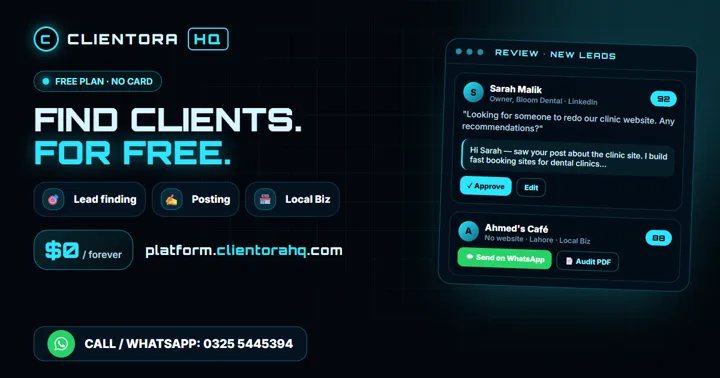
ClientoraHQ is an AI lead generation app that does that searching part. It finds people asking for your service on LinkedIn, Instagram and Facebook groups, lists local businesses without a website, scores every lead from 0 to 100 with the reason, and drafts the message. You approve before anything is sent. The desktop app has a 14-day trial for $25, and there's a free web plan on platform.clientorahq.com that runs on your own Claude API key. See AI lead generation for freelancers for how it works. You don't need it to get your first client, though. The routine above is enough.
FAQ
Can I get freelance clients with no experience at all?
Yes. Small businesses hire beginners all the time when they can see a relevant sample, a clear price and quick communication. Three focused samples and a narrow offer do most of the work that experience would.
Which platform is best for beginners?
The one where your buyers already ask for help. For local services, that is often Facebook groups and Google Maps. For B2B services, LinkedIn. Marketplaces like Fiverr work too, but they are more competitive, so a narrow gig helps.
How many messages should I send a day?
Five to fifteen genuinely personal messages a day is plenty. Quality beats volume, and sending fewer messages keeps your accounts safe.
Should I work for free to get reviews?
One small free sample to open a conversation can work. Long unpaid projects rarely lead to paid work. Charge a fair beginner price with a clear scope instead.